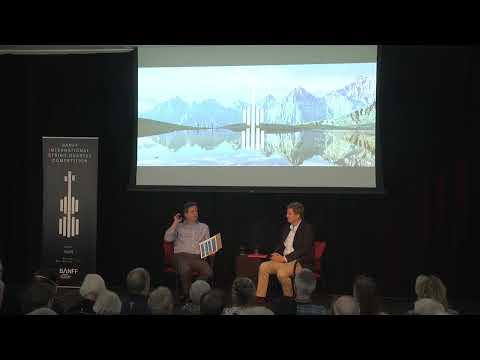
The name is a room. Before it was a genre it was a place: musica da camera, music for the chamber, as opposed to music for the church or the theatre. It was written to be played among friends in ordinary rooms, by people who were often the only audience it would ever have. Everything that makes chamber music what it is follows from that fact.
There is no conductor. Four or five musicians must agree, in real time and without an arbiter, on when to breathe, when to press forward, when to yield. Every entrance is a decision someone has to take and the others have to trust. Goethe, writing to his friend the composer Carl Friedrich Zelter in November 1829, found the image that has never been bettered:
Exhibitions of that kind have always been, of all instrumental music, the most intelligible to me: one hears four rational people conversing among themselves, one fancies one has something to gain from their discourse, and one comes to know the particular character of the instruments.
The players face one another rather than the room. What an audience overhears is a conversation it was not, strictly speaking, required for, which is exactly why hearing it feels like a privilege rather than a performance.
Haydn is usually given the credit for the form, and he earned it: across some sixty-eight quartets he worked out how four string instruments could be equals rather than a melody with accompaniment. What he built became the place composers went when they had something they could not say in public. Mozart wrote his most confessional music into his quintets. Beethoven ended his life inside the late quartets, music so far ahead of its players that it waited decades for performers to catch up. Schubert, Brahms, Shostakovich: the pattern holds. The symphony is what a composer says to the world. The quartet is what a composer says to four people in a room.
That intimacy is not a metaphor. In a chamber concert you can hear the rosin, the breath before an entrance, the small sounds of bodies working. You can see a glance pass between two players and then hear what it meant. Nothing is amplified and nothing is hidden. The music is being made in front of you, at the scale it was written for, by people close enough that you would notice if one of them faltered.
This is why a village hall on the Dingle Peninsula is not a compromise for this repertoire but its natural home. Music written for rooms works best in rooms. The great concert halls came later, and much of what they gained in grandeur they lost in proximity. In August, in Ballyquin and Castlegregory, the music returns to these original conditions: a modest space, a few dozen listeners, and no distance between the players and the people they are playing for.